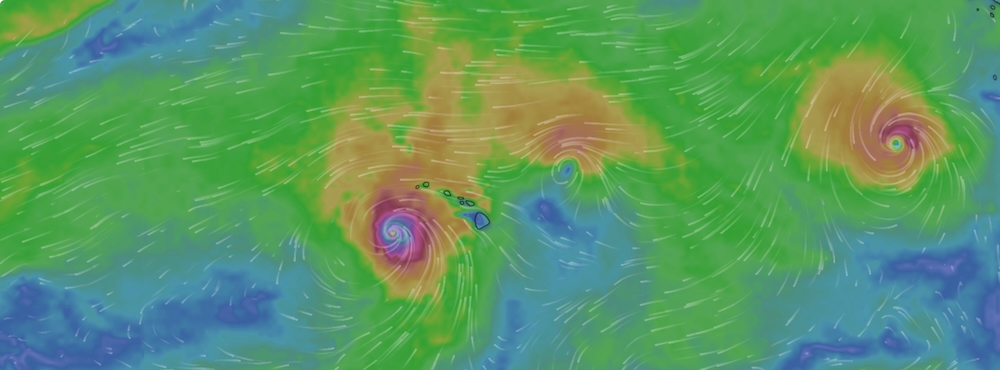
Recently we saw many people confused in Facebook posts about storm names. Why did Iselle (i) come after Moke (m) when storms names are supposed to be alphabetical?
There are seven officially recognized tropical cyclone basins worldwide (listed at bottom of this post).
Each basin cycles through its own list independently, so it’s normal to see “L, M” in one basin and “I” active at the same time in another — they’re not sequential letters in a single list, just two unrelated storms being named in parallel.
Lala and Moke were from the Central Pacific storm name list, the one used for systems that form (or move into) the region around Hawaii.
Iselle is from the Eastern Pacific list — a separate basin with its own alphabetical sequence, which tracked well east of Hawaii near Baja California.
Interestingly, “tropical cyclone” is the generic meteorological term for this type of storm system worldwide. “Hurricane,” “typhoon,” and “cyclone” are just regional names for the same phenomenon, based on which basin it forms in.
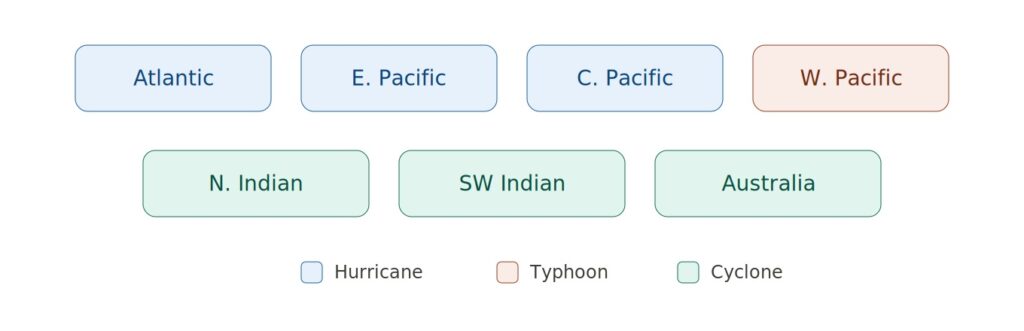
- Atlantic — includes the Gulf of Mexico and Caribbean
- Eastern Pacific — off the west coast of Mexico/Central America
- Central Pacific — centered around Hawaii, roughly 140°W to 180°
- Western Pacific — includes the Philippines, Japan, and East Asia (storms here are called typhoons)
- North Indian Ocean — Bay of Bengal and Arabian Sea
- South-West Indian Ocean — off the east coast of Africa, including Madagascar
- Australian/South Pacific — split further into sub-regions (Australian region, and South Pacific)